Why does 3D audio so often come down to spinning sources?
Spins, orbits, sweeps over the audience: in immersive audio, moving sources has become the standard demonstration, especially in tools built for DJs. Technically, it is most often an autopan carried into three dimensions: a periodic modulation of azimuth, or a preprogrammed trajectory triggered live.
In stereo, nobody builds a mix on a permanent autopan. Auditory perception shows that sound space is built mostly from cues of distance, size and relation to the room, which listeners perceive consistently wherever they stand. This article examines why spinning became the norm in 3D and what it actually produces perceptually. It then describes what builds space, applies these principles to the stereo material DJs play, and details how to set them in RIPL, our spatialization software.
An observation: the trajectory as showcase
Presentations of immersive systems, especially for the electronic music scene, almost always put source movement first: an element of the track that orbits, crosses the room or passes over the audience.
Recent products show this, whether they target the stage, the studio or research. They fall into three families:
- Stage and DJ tools, where movement is played live:
- L-Acoustics DJ (released in October 2025, installed at Bootshaus in Cologne in June 2026) isolates elements of a track and places them in the room. Its documentation emphasizes positioning and moving them in real time, using "motion animators" and "predefined trajectories designed for DJs".
- The Ambrio Spatial Performance Mixer, a mixing console announced in October 2026, gives each channel 360° positioning and movements whose shape and speed can be set and played live.
- Spacemap Go (Meyer Sound) highlights panning trajectories drawn with a fingertip on iPad and recorded for playback during the show.
- Oscillators, which spin the source continuously:
- SPAT Revolution (FLUX::) offers an animation system whose LFOs modulate source azimuth, with a distributed phase offset when several sources share the same oscillator. Strictly speaking, this is an autopan in three dimensions.
- 3D Panner (Almudio, free, July 2026) places sources on a sphere around the listener, rendered binaurally. Eight LFOs move them in orbits, spirals, pendulums or figure eights, and users can draw their own path. The product page mentions no room, no reflections and no reverberation.
- The Spatbox (Pierre Lecomte, Université Lyon 1, SMC 2022) takes this logic to its end. Each coordinate of the source follows an LFO set as on a synthesizer, drawing helices, ellipses and "flowers" rendered in Ambisonics. Space is reduced to the position of a point: distance becomes a 1/r gain, a delay and near field filters, with no room, no reflections, no width and no directivity. Reverberation appears only as future work: the panning law chosen for the embedded version rules out any processing before decoding. The author also considers visual feedback essential, since the ear alone cannot follow the trajectories.
- Sequencers and written trajectories, which replay a path locked to the music:
- The Dolby Atmos Music Panner adds to DAW panners a sixteen step sequencer locked to the session tempo. Users draw freehand the path the object will follow, step by step. Movement becomes a repeated rhythmic pattern, and position remains the only spatial parameter in play.
- Beat Panner (Sound Particles, February 2026) takes up the idea with 32 steps per channel and more than thirty immersive formats, from 5.1 to 22.2. The publisher presents it as a tool that "plays" sound instead of placing it. Spatialization is openly treated as a rhythmic gesture of position.
- SpatGRIS and its ControlGRIS plugin (GRIS at Université de Montréal and Société des arts technologiques) are used to compose trajectories in the DAW, then replay them on a dome or cube of up to 256 channels. Control messages describe only a position and a spread. The documentation mentions no room model.
These tools are technically accomplished, and several offer many other parameters. The question here is not their quality but the use they put forward: movement takes center stage, while it is only a small part of what spatialization allows. All of them treat space as a position to be moved. Distance, source size and relation to the room stay in the background, when they exist at all.
At the other extreme, some solutions give up any gesture. They hand the field to a fully automatic upmix, such as Audiolift, which avoids excess movement but freezes the space. As we will see, neither approach builds a space.
The stereo precedent
Autopan has been available on consoles and in software for decades. Yet it remains an occasional effect: applied to one element, for a limited time, with an identifiable musical intent. No established stereo mixing practice relies on continuous source movement.
In stereo, the perception of space rests on other levers:
- fixed lateral position, obtained through level differences between channels;
- depth, produced by level, reverberation, high frequency attenuation and early reflections;
- apparent width, controlled by the correlation between the two channels.
A finished stereo mix produces a stable scene organized in planes. If source movement never structured two channel mixing, nothing suggests it should structure mixing over several dozen channels.
The reasons for a reflex
The place taken by movement is explained more by demonstration and interface constraints than by perceptual criteria.
- Proof by movement. A fixed source behind the listener can go unnoticed. A source travelling around the room immediately demonstrates the reach of the system.
- The plan view. Most interfaces show the room from above. When position is the only visible parameter, it becomes the only parameter people touch.
- An impoverished object model. In many engines, a source comes down to an azimuth, an elevation and a distance that acts only on level. Without size, directivity or interaction with the room, angle is the only variable left.
- The need for a live gesture. DJs expect immediate feedback from their actions. A trajectory control provides it; building a perspective is less visible.
- The novelty of the medium. Early stereo mixes likewise exaggerated left right separation, before practice settled.
None of these factors follows from the properties of spatial hearing.
What perception does with movement
The spatial resolution of hearing is strongly anisotropic, and a circular trajectory passes precisely through the regions where it is weakest.
- Angular resolution. The minimum audible angle is about 1° straight ahead but grows sharply toward the sides (Mills, 1958). Localization blur, about 3.6° to the front, reaches around 10° at the sides and more in elevation (Blauert, 1997). Laterally, the cone of confusion makes front and back ambiguous. The threshold for detecting movement (minimum audible movement angle) is also higher than the threshold for telling two fixed positions apart (Perrott and Musicant, 1977).
- Dependence on listening position. Outside the central listening area, the precedence effect places the source on the loudspeaker whose signal arrives first (Wallach et al., 1949; Litovsky et al., 1999). For most of the audience, a continuous trajectory is therefore heard as a series of jumps between loudspeakers.
- Attention and habituation. Movement triggers an orienting response, which fades through habituation when the stimulus repeats (Sokolov, 1963). Continuous movement first draws listening away from the musical content, then stops being perceived as an event.
- Stable references. The readability of a mix relies on stable spatial relations between its structural elements (kick, bass, vocals). Moving them changes these relations without enriching the scene.
- Comb filtering. Summing coherent copies of the same signal, received with different delays, produces comb filtering that depends on the source position. In motion, it becomes a varying coloration, comparable to a phasing effect.
Movement is therefore a salient but fragile cue. It is not enough to build a space: what does build it remains to be established.
What builds space
Moving sources is only a special case of spatialization. We start from its definition, valid for any system, then from the perceptual cues that organize a field into planes. With these principles in place, we look at what they imply for DJ stereo, then at how RIPL implements them.
What spatialization covers
To spatialize is to build a sound place and to organize relations within it: distance, apparent size, envelopment, orientation, interaction with the acoustics of the room, the listener's point of view.
This definition applies whatever the content:
- amplified concerts and DJ sets: a scene that reads across the whole audience area, not only in the central zone;
- theater and dance: voices consistent with the performers' positions, sound sets with depth;
- installations: a stable space through which visitors move;
- broadcast and headphone listening: a coherent field that carries over from one playback system to another.
In each case, movement is one tool among others. Space comes first from distance, size, orientation and relation to the room.
Thinking in planes rather than trajectories
A convincing immersive sound field is organized in planes: a precise foreground, a stage, a background and an enveloping field. Each plane rests on cues whose role in the perception of distance and space is established in the literature (Zahorik et al., 2005).
| Cue | What it conveys | Near source | Distant source |
|---|---|---|---|
| Direct to reverberant ratio (DRR) | absolute distance in the room (Bronkhorst and Houtgast, 1999) | direct sound dominates | reverberant field dominates |
| Air absorption | distance travelled | high frequencies preserved | high frequencies attenuated (ISO 9613-1) |
| Early reflections | room dimensions, source position | large gap between direct sound and first reflections | reflections close to the direct sound |
| Apparent source width (ASW) | extent of the sound object (Barron and Marshall, 1981) | narrow, localized | diffuse, extended |
| Level and near field effects | immediate proximity | presence, bass boost | lower level, high frequencies attenuated |
Listener envelopment (LEV) depends on late lateral energy (Bradley and Soulodre, 1995). These cues depend far less on listener position than angle of incidence does: a source rendered distant is heard as distant by the whole audience, whereas a trajectory reads only at the center.
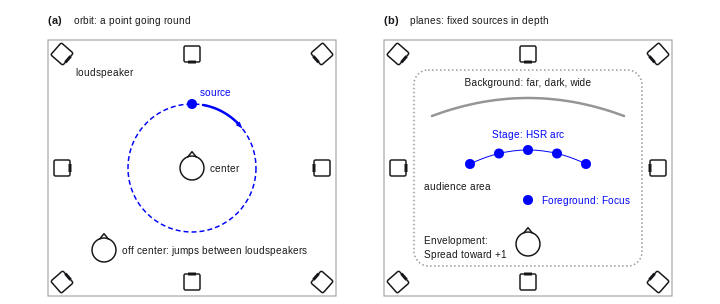
Fig. 1. Orbit versus perspective, plan view of a room with eight loudspeakers. (a) An orbit reads only at the center: the central listener follows the circle, while off center the image jumps from one loudspeaker to the next. (b) Fixed planes in depth read throughout the room: foreground set by Focus, stage as an HSR arc, background far, dark and wide, envelopment by Spread toward +1.
On the left, only the central position perceives a circular trajectory. On the right, the distance and size of each plane stay stable across the whole audience area.
What to do with stereo?
Thinking in planes requires sources that can be placed and shaped. Yet DJs play tracks that are already mixed and mastered in stereo. The first question is therefore not movement, but how to render this two channel signal on a system of 8, 16 or 40 loudspeakers without giving up planes. Four families of solutions coexist.
| Approach | Principle | Strengths | Limits |
|---|---|---|---|
| Replicated stereo | left and right channels distributed over groups of loudspeakers | simplicity, faithful to the track | image limited to the axial zone; elsewhere, precedence effect toward the nearest loudspeaker |
| Source separation | track split into vocals, drums, bass and the rest, each component handled as an object | independent objects | separation artifacts, loss of the original mix's cohesion; invites moving the objects |
| Automatic upmix | multichannel field computed by signal analysis, with no intervention | no preparation, whole track preserved | field shape fixed by the algorithm, little control for the operator; often tied to a given channel count |
| Recreated, adjustable field (HSR) | content of the stereo image distributed over sub sources placed in space | whole track, no separation; adjustable field; independent of loudspeaker count | requires thinking in planes rather than trajectories |
Automatic upmix answers a real operational constraint: switching between artists with no preparation. Audiolift, for example, promises to turn "any stereo mix" into a spatial scene in real time, "without preparation", over at most 32 Dante channels. Its public documentation describes routing, snapshots and coverage simulation, but no control over the width, distance or depth of the field.
This approach has three limits in principle:
- A field without intent. The analysis alone decides what belongs to direct sound and what belongs to ambience. The same processing applies to an intimate vocal, a techno track or a live recording, although each calls for a different spatial organization.
- Widening is not depth. Spreading the stereo image over more loudspeakers extends it sideways or around the audience. It does not create planes: without acting on the direct to reverberant ratio, absorption or apparent width of each component, the field remains stretched stereo.
- Irreversible extraction errors. Any separation between direct and diffuse components makes mistakes: smeared transients, vocal reverb sent to the sides, decorrelated content that colors the timbre. When the operator has no parameter, they can neither correct these errors nor redistribute them.
The result is convenient; it remains whatever the algorithm decided. Permanent movement and full automation are thus two symmetrical excesses: the first agitates the field, the second freezes it.
HSR (High Space Resolution), our upmix algorithm, seems to us the most viable path. It does not split the track. It continuously analyzes the correlation between the left and right channels, in the time domain and without block latency, and recreates the field the stereo already contains: a center, sides, wide components and localized ones. It then exposes the properties of this field as parameters: width, opening, center and edge weighting, orientation, distance.
This field is described in space, not in channels. The same setting renders on 8 loudspeakers, on a WFS array of several dozen loudspeakers or binaurally on headphones, with the engine computing the gains for the system in place. These parameters are detailed below, along with those RIPL applies to every source.
Implementation in RIPL
RIPL makes these cues available source by source, without relying on movement. Two sets of parameters handle this: HSR for stereo sources, and the Space section for all sources.
HSR: setting the recreated field
HSR distributes the content of the stereo image (center, side and intermediate components) over a set of sub sources laid out along an arc. The arc follows the orientation of the source: facing the audience, it forms a stage; set back, a background; wrapped around the room, an enveloping field.
| Parameter | Effect | Use in perspective |
|---|---|---|
| Arc length | physical width of the field; RIPL picks 3, 5, 7 or 9 sub sources depending on this length | a stage a few meters wide, or a layer covering a whole wall |
| Divergence | shifts the content carried by each sub source by the same amount toward the sides of the stereo image (+) or toward its center (−); the central sub source does not change | tighten a foreground element, open up a background |
| Balance | weighting between the sub sources that carry the center of the image and those that carry its sides | a dense, precise center, or edges that carry the ambience |
| Steer | orientation of the sub sources toward the arc axis, increasing toward the ends | focus the field on the audience or open it toward the room |
| Aperture | radiation opening of the source, and of each sub source in manual mode | choose which loudspeakers each region of the image excites |
| Manual mode | pan and weight of each sub source | bring the central component of a track forward while leaving the side components behind |
None of these parameters moves the source. They change its width, perceived distance and orientation: the field changes shape without changing place.
The Space section: shaping each source
The Space section of each source acts directly on the cues described above.
Width: extent of the sound object
- Size widens the image through decorrelation, on the same loudspeakers. At 0, the source is a point; above that, its apparent width increases.
- Size by phase replaces decorrelation with a phase distribution: each loudspeaker receives the signal shifted by its own constant phase angle. With equal arrival times, the sum keeps a flat spectrum, without the comb filtering that decorrelation introduces (mono sources).
- Spread ranges from a single loudspeaker (−1, the farthest loudspeakers fading out first) to a uniform distribution over all loudspeakers (+1). It takes a source from a localized object to an enveloping field.
Propagation: distance
- Air applies air absorption as a function of distance, based on the temperature and humidity set for the project. It acts on the direct sound, the monitoring and the reverb reflections.
- Proximity Compensation limits the level rise of a source close to a loudspeaker, following the 1/r law, with a maximum reduction (Reduction, in dB) below a reference distance (Distance).
Focus: foreground within the audience
- In wave field synthesis (WFS), Focus makes the wavefront converge on a point in front of the loudspeakers. The source is then perceived within the audience space rather than on the loudspeaker line.
- Focus Area sets the extent of the region around the focal point over which this field is reproduced; Robustness sets the tradeoff between sharpness of focus and size of the valid zone.
Orientation, opening and reverberation
Orientation and radiation opening determine which loudspeakers a source excites, and therefore its relation to the room. Reverb sends set the direct to reverberant ratio, the most robust distance cue in a room.
Together, these parameters give each source a position in a space of several dimensions (distance, width, envelopment, orientation, focus), where a trajectory based approach handles only one.
Applying it to a set
The layout below is a starting point for a club set, to be adjusted by ear in the venue. Sources stay fixed; space results from how they are distributed in planes.
| Plane | Elements | Placement | RIPL parameters |
|---|---|---|---|
| Foundation | kick, bass | facing the audience, centered, fixed | Size at 0, Spread near 0, little reverb |
| Foreground | vocals, lead element | in front of the loudspeakers, within the audience | Focus (WFS), low Size, Proximity Compensation and Air on |
| Stage | main stereo track | HSR arc a few meters wide facing the audience | medium Divergence, Balance toward the center, Steer toward the audience |
| Background | pads, the track's reverbs | behind the stage, long HSR arc | open Divergence, high Size, Air on, stronger reverb sends |
| Enveloping field | ambiences, textures | around and above the audience | Spread toward +1, Size by phase, low level |
Three principles keep the scene readable:
- The foundation stays fixed.
- Only one element occupies the foreground at any given time.
- The background stands apart through distance cues (DRR, absorption, width), not through level alone.
The place of movement
Movement keeps its value when it is rare, motivated and slow.
- A change of plane rather than an orbit. Bringing an element from the background to the foreground (rising DRR, falling Size) is perceived across the whole audience area; a rotation is perceived only at the center.
- An event rather than a state. Kept to a transition or a break, movement keeps its orienting value and escapes habituation.
- One element at a time, never a structural element of the groove.
- A written trajectory. A trajectory drawn and automated in the RIPL timeline, synchronized with the music, rather than a continuous oscillator or a pattern repeated in a loop.
Electroacoustic music offers early examples. Stockhausen's rotation table for Kontakte (1960) and Chowning's simulation of moving sources (1971) make movement a compositional figure, written and placed within the work, not a permanent state. Chowning also went beyond angle: his method set distance through the balance between direct and reverberant sound, and added a Doppler shift to convey speed.
Conclusion
Spinning became the norm in 3D audio for reasons of demonstration and interface, not perception. A trajectory reads only at the center of the room, whereas distance, width and relation to the room are perceived across the whole audience area.
Building space therefore means organizing planes: a foreground, a stage, a background, an enveloping field. For DJ stereo, this calls for a recreated, adjustable field rather than source separation or a frozen upmix.
Stereo practice kept autopan for the moments where it has a function. The same rule holds in immersive audio: space is built first in depth, and movement remains an event.
References
Products cited
- L-Acoustics DJ, product page
- L-Acoustics DJ: iPad app and controllers, MusicTech, January 24, 2026
- Bootshaus upgrades to L-Acoustics DJ, USITT, August 31, 2026
- Ambrio Spatial Performance Mixer, MusicTech, October 2026
- DJ Mixer With Spatial Sound Capability, Sonicstate, October 20, 2026
- Audiolift, home page
- SPAT Revolution, Animation System, FLUX:: documentation
- Meyer Sound releases Spacemap Go, Rave Pubs, October 28, 2020
- Dolby Atmos Music Panner, Dolby product page
- Using the Dolby Atmos Music Panner, HHB guide
- Sound Particles Beat Panner, Production Expert, February 6, 2026
- Almudio 3D Panner, product page
- SpatGRIS and ControlGRIS, GRIS repository (Université de Montréal)
Literature
- Barron, M. and Marshall, A. H. (1981). Spatial impression due to early lateral reflections in concert halls. Journal of Sound and Vibration, 77(2).
- Blauert, J. (1997). Spatial Hearing: The Psychophysics of Human Sound Localization, revised edition. MIT Press.
- Bradley, J. S. and Soulodre, G. A. (1995). Objective measures of listener envelopment. JASA, 98(5).
- Bronkhorst, A. W. and Houtgast, T. (1999). Auditory distance perception in rooms. Nature, 397.
- Chowning, J. M. (1971). The simulation of moving sound sources. Journal of the Audio Engineering Society, 19(1).
- ISO 9613-1 (1993). Acoustics: Attenuation of sound during propagation outdoors, Part 1: Calculation of the absorption of sound by the atmosphere.
- Lecomte, P. (2022). The Spatbox: An Intuitive Trajectory Engine to Spatialize Sound. Proceedings of the 19th Sound and Music Computing Conference, Saint-Étienne. HAL hal-03781074.
- Litovsky, R. Y., Colburn, H. S., Yost, W. A. and Guzman, S. J. (1999). The precedence effect. JASA, 106(4).
- Mills, A. W. (1958). On the minimum audible angle. JASA, 30(4).
- Perrott, D. R. and Musicant, A. D. (1977). Minimum auditory movement angle: binaural localization of moving sound sources. JASA, 62(6).
- Sokolov, E. N. (1963). Perception and the Conditioned Reflex. Pergamon.
- Wallach, H., Newman, E. B. and Rosenzweig, M. R. (1949). The precedence effect in sound localization. American Journal of Psychology, 62(3).
- Zahorik, P., Brungart, D. S. and Bronkhorst, A. W. (2005). Auditory distance perception in humans: a summary of past and present research. Acta Acustica united with Acustica, 91(3).